
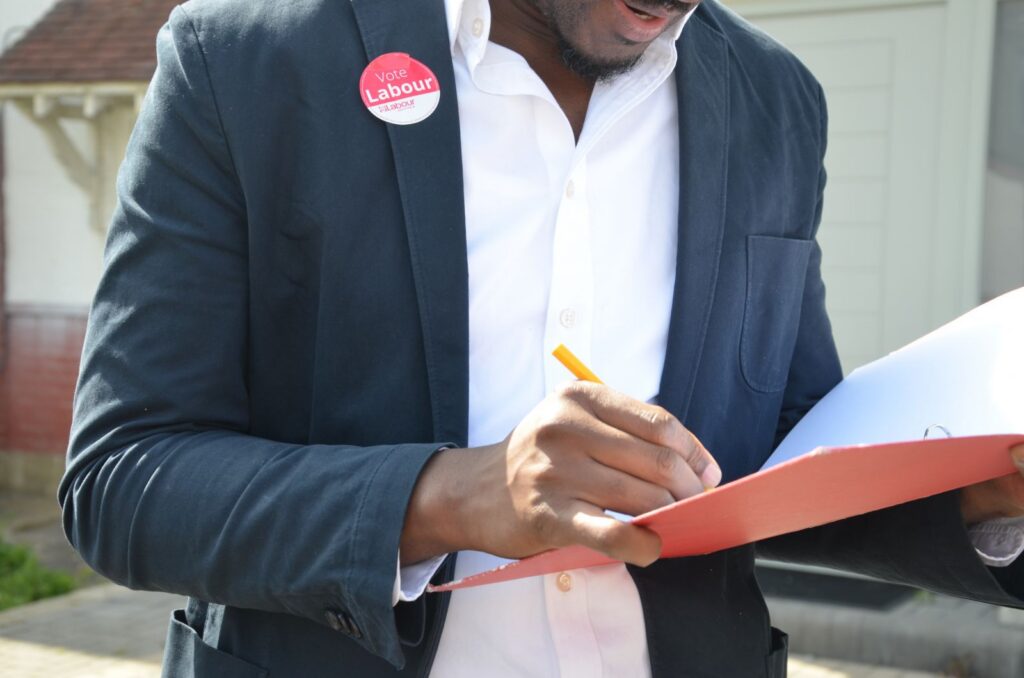
Cllr Matt Stanton – Beam Park Labour Councillor
Elections are always a little bruising. Even if you win, you hear ‘no’ an awful lot, and the no’s seem to stick with you longer than the yeses.
On the surface, politics seems like something that should be very straightforward but is not. You go out to someone and say, ‘I want to improve your life,’ they vote for you, and you go ahead and do it. But we all know it is far more complicated and changeable than that.
First is the messy, not always coherent, way that politics, and the state, have evolved. As a local councillor, I hear from people who want to know about infrastructure, GP’s, schools, dentists, even rail stations. But the levers we have, to pull on those things are more limited than people are willing to accept.
Even on the things that are within the realm of local government, Housing, parking tickets, bins, at best we can nudge the process a little. Day-to-day? It’s going in a direction decided years ago. All of this adds up to something that’s very confusing for people and takes a bit of unpicking.
Everything seems to take forever. Preventing crashes by adjusting traffic lights at a junction? Four years. Building new houses? Longer. Getting the Council, or the NHS, to accept that they may have made a bad decision, and correcting it? Institutions are defensive and risk-averse, even when it harms the very people they are supposed to serve. When institutions feel separate from populations, that’s a point of failure. It should be our Council, our NHS, our government. Things should be done by and with people, not for them.
With so many people being time-poor, it’s little wonder that for the majority of people at the last election, voting wasn’t a priority. When you are working harder than ever, to spend more of your money than ever, on rent and bills, that home, that shelter, that’s costing you everything you have, is the place you want to turn into an air raid shelter from the slings and arrows of life.
I don’t look down on those people – they either feel that no matter who they vote for, the outcomes are fixed, or they feel that they have no one to put their faith into. If the sum total of our activity is to leave ordinary people feeling that year on year, things are getting harder, scarier, and with less chance of things improving, then we have failed.
That’s on us, then, to be that person, to build that relationship and that trust, to give people a reason to participate.
I want to linger on that word – participate. For a long time now, we have had representative democracy, we vote for someone to represent us at the Council and at Westminster, or City Hall, for a period of years. And in a sense, that’s appropriate. Life, government, the state, is more complex than it was. Things are set out that take 20-30 years to come to fruition, and if every time a representative changed, plans had to change, nothing would get done. Governance should also not be carried out according to people’s whims, or for the benefit of a noisy minority.
Giving representatives time and distance from the electorate means that they can be dispassionate and make better choices.
But that shouldn’t eliminate listening, nor should it eliminate keeping in touch with people and their concerns. Too often now politics is seen as transactional, a vote in exchange for… what? The change that needs to come is to start with turning up to ask people what matters to them, not poking a leaflet through their door and telling them what great things we’ve been up to. People should inform politics, not the other way around.
I think people are uncomfortable sometimes about asking that question because they are afraid of an answer that opposes their worldview. Conversations about immigration, or crime, often stem from underlying insecurity and fear. No one wants to suffer from crime, and while its people that commit crime, it is structural issues that push people into criminal behaviour. Similarly, the vast majority of people are less concerned with who their neighbours are than they are about increasingly constrained access to housing and public services.
We shouldn’t therefore be afraid to say to someone, ‘no, it isn’t right that your family is overcrowded, but it’s not right for any family, either’. And we shouldn’t be afraid of saying to people that we want to build more houses for people who were born here, but also for people who have moved here to work, to contribute, and build a new life.
The conclusion that we are pushed towards by the individualists is that we are all on our own. Margaret Thatcher may have said that there was no such thing as society, but she was trying to persuade people to act and vote in a particular way, not speaking a scientific truth. But if human experience has taught us anything, its that we have more in common than we think – we struggle, and strive, to secure our circumstances, to raise families, to be better people. And we want that for other people too.
So, when we turn up on doorsteps to say ‘what can we do for you’ we aren’t really saying you specifically, we are saying that you and your neighbours, are in it together. And we’re in it with you. Not for you, not on your behalf. With you, alongside you. Not to solve your problems for you, but to give you the tools to solve them, whether that’s services, signposting, or resilience. Or even just a voice that says, ‘you aren’t alone.’ Because we are not, even when we feel like we are.